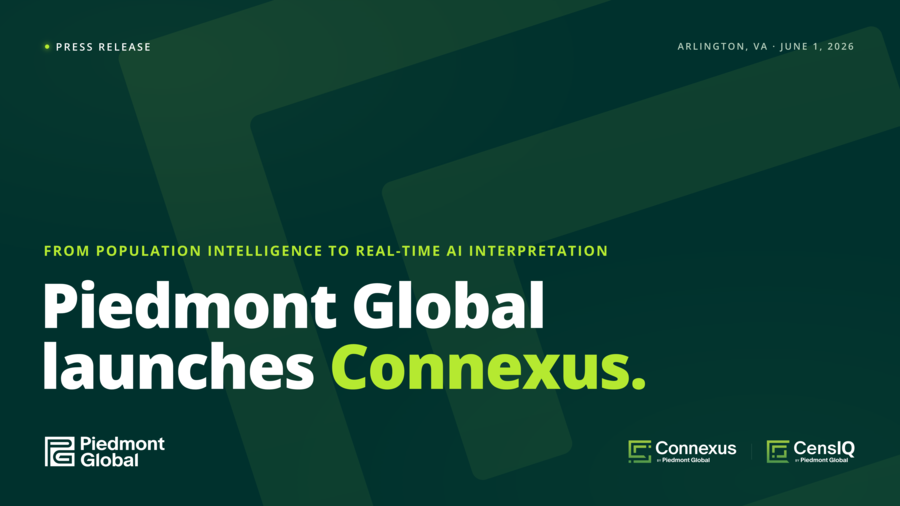
ARLINGTON, VA, June 01, 2026 /24-7PressRelease/ — Piedmont Global, a Strategic Globalization Organization (SGO), today announced the launch of two platforms: CensIQ™, a population intelligence and language access planning platform, and Connexus™, an enterprise interpretation management platform. Together, they represent the first public expression of Piedmont Global’s SGO model, linking population intelligence, policy alignment, organizational planning, and service delivery through a unified insight-to-action architecture. CensIQ provides the intelligence layer, helping organizations understand evolving language access needs while aligning policies, plans, and resources to meet them. Connexus serves as the delivery platform through which human interpreters and AI-powered interpretation services are deployed, managed, and measured across every modality.
Connexus responsibly consolidates human and AI interpretation within a single delivery model: Over-the-Phone Interpretation (OPI), Video Remote Interpretation (VRI), Onsite Interpretation (OSI), and the real-time Speech-to-Speech AI Interpreter, all in one browser-based platform with 300+ languages and American Sign Language (ASL) embedded across every modality. For healthcare clients, Connexus is designed to be the first EHR-agnostic interpretation platform with instant connectors, built to embed directly in the electronic health record.
Both platforms are built for small- to enterprise-level commercial and public-sector organizations that need compliant, defensible language access at scale across healthcare, financial services, government, education, and other industries where cross-cultural communication is mission-critical.
“For years, language access has treated planning and delivery as separate activities – one focused on what organizations think they need, the other on responding when demand arrives,” said Mohamed Hussein, Founder and CEO of Piedmont Global. “Our view is that they should be part of the same system. CensIQ provides the intelligence to understand populations, anticipate needs, and continuously refine strategy. Connexus operationalizes those insights through a single platform that orchestrates human and AI interpretation across every modality, creating a continuous feedback loop between planning, delivery, and outcomes. This is our first public launch as a Strategic Globalization Organization, and it reflects how we think language access should work: planned against reality, delivered responsibly, and measured against results.”
How does CensIQ work?
CensIQ is a core component of the intelligence layer within the SGO model. Most language access plans are built as compliance exercises – created once, updated infrequently, and disconnected from the realities of implementation. They often describe what an organization intends to do but provide limited visibility into whether meaningful access is actually being delivered, measured, and improved over time.
CensIQ starts from a different premise: effective language access requires alignment. Population needs, policy requirements, regulatory mandates, organizational priorities, budgets, procurement decisions, operational capacity, and frontline service delivery all influence outcomes, yet they are rarely brought together into a single decision-making framework.
CensIQ combines demographic and limited English proficiency (LEP) trend intelligence at ZIP, county, and state levels with organizational data, benchmarking, agentic workflows, and consulting expertise to create a shared understanding of what meaningful access requires. The platform helps align policy with execution, federal and state requirements with local realities, leadership expectations with operational capacity, and community needs with measurable outcomes.
The result is more than a language access plan. CensIQ produces assessments, plans, roadmaps, governance frameworks, performance benchmarks, and strategic recommendations that help organizations understand where gaps exist, prioritize resources, establish accountability, and measure progress over time. Rather than treating language access as a static compliance document, CensIQ enables organizations to manage it as a living operational capability.
How does Connexus work?
The platform consolidates capabilities that have historically lived across two or three separate vendor relationships. OPI, VRI, OSI, AI interpretation, scheduling, interpreter management, call routing, audit-ready Joint Commission documentation, per-minute billing tied to call detail records, and real-time capacity analytics all run inside one browser-based platform. Pricing is usage-based with no monthly platform fees and no minimums.
The Speech-to-Speech AI Interpreter is linguist-led by design. Linguists with sector expertise own the glossary, the interaction guidelines, and the weekly quality-assurance loop, and the service runs under the same accuracy commitment and audit trail as human interpretation. It supports 50+ languages and commits to 95%+ accuracy on domain-adapted language pairs, with a pre-launch glossary build, real-time confidence scoring, and automatic OPI fallback below threshold. The AI is the engine; language professionals are in control.
“Buyers are not asking for another interpretation tool. They are asking for a partner who can absorb the operational complexity of running cross-cultural communication at scale – and prove it in records,” said Mary Grothe, Chief Revenue Officer at Piedmont Global. “That is why we built the SGO model, not just the platform. CensIQ tells clients where the language access gaps are. Connexus closes them. One contract, one SLA, AI scale where it earns its place, humans where the stakes demand it, and the data to defend every decision. That is what our clients are responding to.”
What systems does Connexus integrate with?
Connexus integrates into the systems clients already run, without changing existing infrastructure.
For healthcare clients, that means Connexus is HIPAA-compliant, Epic SMART on FHIR ready, and in final integration certification, with the Redox middleware path in progress to extend EHR connectivity across 95+ systems. The product is designed to be the first EHR-agnostic interpretation platform with instant connectors, built for the realities of multi-EHR health systems and federal healthcare agencies.
For non-healthcare clients, Connexus integrates through SIP trunking, REST API, and direct connectors to Twilio Flex, Genesys, Five9, NICE, Talkdesk, Amazon Connect, RingCentral, and other major contact center platforms.
“We designed everything to embed inside the systems you already run – not to replace them,” said Jeremy Malara, Chief Information and Technology Officer at Piedmont Global. “CensIQ draws its population intelligence from external data sources. Connexus then integrates through Epic SMART on FHIR for the EHR, SIP trunking and direct CCaaS connectors for the contact center, REST API for the data warehouse, and SAML federation for identity. The platform is browser-based, AWS-hosted, ISO 27001:2022 certified, and HIPAA-compliant. IT teams should expect both to fit, not to fight. That is what gets a platform from pilot to production, and what keeps it in the critical path once it is there.”
“What separates the SGO model is intelligence-first and hybrid by design,” said Saba Dovlatabadi, VP of Product at Piedmont Global. “CensIQ tells you which languages and modalities to plan for, and it is built to keep that plan current as your population shifts. Inside Connexus, AI handles scale and human OPI handles the calls that matter, with the routing layer making the decision in real time based on confidence scoring. Clients see one dashboard, one accuracy report, and one audit log across both human and AI delivery. That is not how AI speech-translation vendors are building. That is how a language services company that has been credentialing interpreters for thirteen years builds it.”
How can enterprises and government agencies get started?
Connexus is available beginning today through Piedmont Global’s managed interpretation service and through cooperative purchasing vehicles, including the NASPO ValuePoint Remote Interpreting Services contract and the GSA Professional Services Schedule (Contract #47QRAA18D001Y). Piedmont Global holds ISO 27001:2022, ISO 9001:2015, ISO 17100:2015, and ISO 13485:2016 certifications and is a certified minority-owned business.
Learn more at piedmontglobal.com/connexus or book a demo today.
About Piedmont Global
Organizations quickly outgrow siloed language vendors and one-off interpretation and translation services. As a Strategic Globalization Organization (SGO), Piedmont Global replaces that fragmented, transactional patchwork with a single global operating system that combines strategic insight, cultural fluency, data intelligence, and technology. The SGO model rests on eight solution pillars – the Elite 8 – that cover the full span of cross-cultural work: Language Operations, Accessibility, Staffing, Data Services, BPO, Consulting, Content Solutions, and Open-Source Intelligence (OSINT). Together, they help enterprises and government organizations cut vendor sprawl, strengthen compliance, and connect with diverse domestic communities and global markets alike. Learn more at piedmontglobal.com.
—
For the original version of this press release, please visit 24-7PressRelease.com here
Legal Disclaimer: The content on this page is syndicated from independent third-party providers. Kyrion Media makes no warranties or representations regarding the accuracy, completeness, legality, or reliability of the information, including text, images, videos, or licenses. If you are affiliated with this content or have any complaints, copyright concerns, or requests for removal, please contact us at retract@kyrionmedia.com with the specific URL of the content in question. We will review and address valid requests promptly.